

Hello, hello!
I’m writing to you today from a flex desk at my coworking space in Amsterdam. I’m on the second floor of a canal house that faces the Herengracht, one of the main canals in the center of the city. It’s sunny — finally! The streets are swarming with tourists, and there are little green leafy buds on the tree branches.
This city is so beautiful in the spring, summer, and fall that it makes up for the long, dark, and wet winters. I’m actually wondering what I’m doing here, typing on my computer instead of roaming the streets or sipping a cold beer while sitting at a café terrace, but here we are.
I’ve been in a bit of a reading frenzy lately, which I’m not mad about. I recently discovered worldofbooks.com, where you can buy secondhand books at really great prices, and it has reminded me of my preference for paperback books (rather than reading on my Kindle). I like underlining sentences and leaving notes in the margins. I just ordered a handful of used books on the topic of loss and grief because a) it’s relevant to me right now and b) I’m doing research to see if there’s space in the market for my story.
For a while now, I’ve been toying with the idea of writing a non-fiction book, but with very little knowledge of how book publishing works and good old imposter syndrome, I haven’t gotten very far. Like, who would want to read my story? Also, what is my story, really?
I recently learned that with memoir/non-fiction books, you don’t actually write the book up front. You (attempt to) sell it with a book proposal, which is essentially a business plan for your book, outlining its chapters, audience, where it fits in the market, and why it matters, and you include a few sample chapters in the hope of finding an agent. Then they tear apart your idea and help you shape it into a book people would actually want to read. Just kidding, I have no idea if they tear it apart, but I think they probably influence how it shapes up.
Anyway, Things in Nature Merely Grow by Yiyun Li has been on my list for a while. If I’m into a book, I usually read it quite fast. Like, within one to three days, depending on how long it is. This book is 172 pages, and I could have finished it in one sitting, but I didn’t want to. I wanted to take my time. I wanted to sit with it. I wanted to soak it in because Li’s approach to grief — at least from what I learned from this book — is that, in short, we’re approaching it all wrong. And maybe “grief” isn’t even the right word?
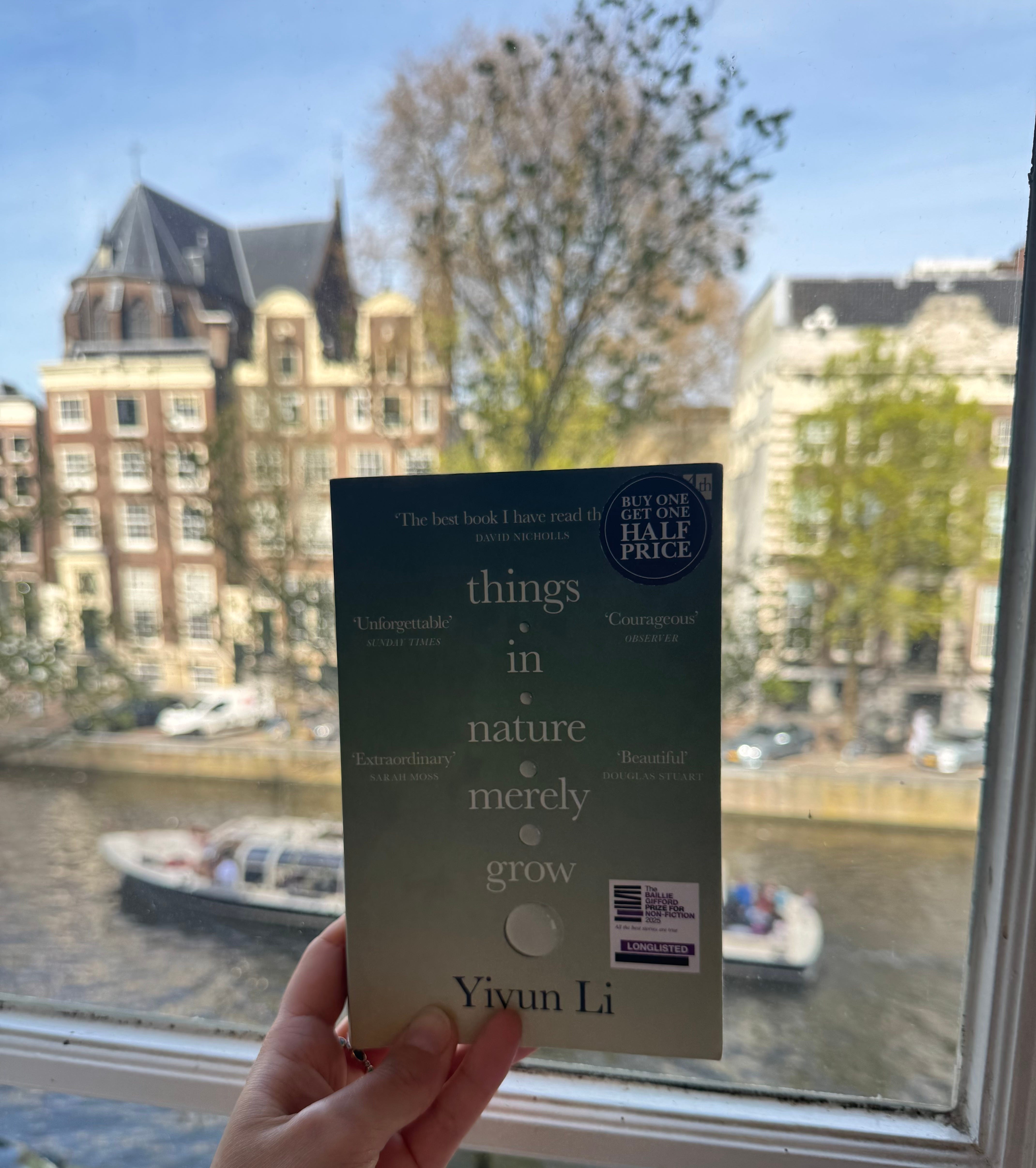
On page 154, Li writes:
“We like to set our hearts on a finish line, hoping to take the right actions so that we can reach that finish line fast and with the least hassle or pain. Perhaps this urge reflects a desire to mark time in a different way: to harness time for gain. And yet in life, time cannot be harnessed.”
When we think about grief, we think that it starts, there’s a messy middle, we get through it, and then we move on. But I think we have an ongoing relationship with it and the person we lost, so can you really move on?
It’s continuous, and I feel like it could always be there, so you need to accept it and live with it, and actually that’s not so bad… It’s even enlightening at times.
Things in Nature Merely Grow is introspective but unsentimental. It’s about radical acceptance. Rather than offering a narrative of healing or resolution, Li writes about literature, philosophy, and daily life. It feels like she’s sitting with her sadness, pain, and guilt — and allowing us to pull up a chair — rather than trying to explain it. Li resists the idea that loss can be transformed into meaning or growth; instead, she writes about endurance and how we must learn to continue to live alongside what cannot be fixed.
Her story is quite devastating — she lost both her sons to suicide, six years apart — but still, she writes about her losses in a way that feels almost anti-performative. She doesn’t make any big declarations; there are no tidy narrative arcs. She even adds touches of humor in the chapter where she writes about all the wrong ways that people tried to console her.
So I guess this was my long-winded way of saying that I loved the book. I will read it again and again. And for anyone who likes memoirs, if you can handle the topic of losing a child (I don’t blame you if you can’t), I recommend reading it. Now I’m off to enjoy some sunshine!
See you soon,
Alexis
P.S. If you’ve read Things in Nature Merely Grow, I’d love to know your thoughts!
Sounds like a very interesting book! Will read.
I saw this in a bookshop last week, I wish I'd bought it! There's much light that can come out of sorrow. Thanks for this Alexis. 🙏🏻