


Hi friends,
The other night, I told my boyfriend that even adding something as light as a feather to my mental load might break me. Then I went down a familiar Google rabbit hole—this time, searching “mental load.” You know, that invisible weight we carry from all the tiny (and not-so-tiny) decisions, tasks, and emotional labor that make up our lives.
I took a 24-question mental load quiz that I found online to validate what I already knew. It was simple—just rate how much you agree with statements about your day-to-day responsibilities. I took it with a grain of salt, of course. Still, I scored 21% higher than average. The quiz didn’t ask for my age or personal context, but even so, the results made me pause.
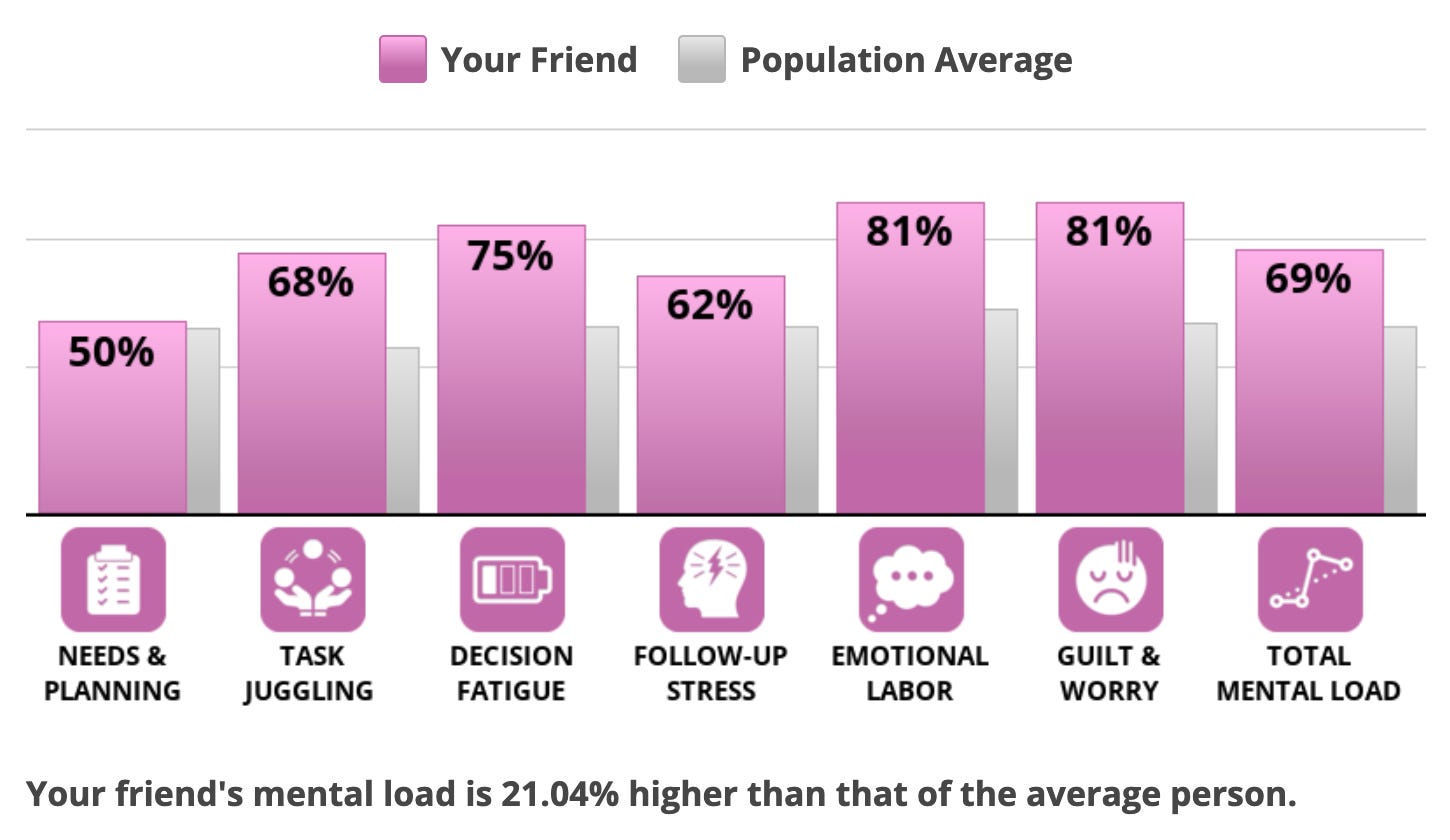
How much of my stress is truly unavoidable? And how much is within my power to change?
Some of it, I can’t change. I can’t undo the fact that my mom has dementia. I can’t avoid managing her finances, healthcare, and paperwork from across the ocean. I can’t outsource the emotional weight of slowly losing her to a disease that steals memories one by one. But I can do some things. Small things. And those small things add up.
So, I made a list of everything occupying my brain—visible and invisible to others, daily and weekly. When I looked at it, I thought: no wonder I feel like I’m about to crack.
Then, I started experimenting with a few changes to lighten the load. None of them is groundbreaking. Some are obvious. But they’re helping. A little. And a little is better than nothing.
1. Putting my phone on airplane mode and keeping it out of sight
One of the first things I tried was putting my phone on airplane mode and keeping it out of sight. At 9 pm, it goes into a drawer, and I don’t turn it back on until I’ve had at least two hours to myself in the morning—to journal, read, or just stare out the window.
When I fall off the wagon and check it first thing, I feel the difference. I’m overstimulated and unfocused. I feel shitty, like I skipped an important meeting with myself. I’ve fantasized about getting a burner phone—a little green Nokia like when I was 20—but living abroad makes that unrealistic. My family needs a way to reach me, and I want to be reachable, just not all the time, so airplane mode helps with this.
2. Decluttering regularly
After feeling inspired by Kate Harvey’s piece about freeing yourself from clutter, I grabbed two garbage bags—one for donations and one for trash—and went through every drawer and closet in our apartment. It’s wild how much mental weight is tied to physical stuff, even when it’s out of sight. I plan to make this a regular habit, instead of waiting until the piles of paper or random cables stress me out.
3. Enforcing a “no buy” year
This led to a more extreme experiment: a no-buy year. I already follow a one-in, one-out rule with my closet, but I wanted to take it further. No new clothes for a year. Not because I’m a minimalist saint or a retail therapy addict, but because there are still clothes I never wear. I want to challenge myself to repurpose what I have and pare down even more. I’ll revisit my closet each quarter and let go of whatever isn’t working.
I’m working on a post sharing my top 3 rules and exceptions for my no-buy year. Stay tuned, and feel free to ask me anything about this in the comments of this post! (Or share what has worked for you!)
4. Unsubscribing from emails about doing or achieving more
I have six email addresses (don’t ask) and was subscribed to dozens of newsletters I never read. Most of them were about doing more, achieving more, and optimizing more. I had auto-archived them into folders like “News” and “Research,” which sounds productive but was really just digital hoarding.
So, I unsubscribed from most of them. Gmail’s hover-and-click feature made it easy. I did it while binge-watching Bad Sisters. Now, I try to stay on top of it weekly.
5. Removing email inboxes from my iPhone
I toggled email off for a day just to see what would happen. I reached for my phone constantly—out of habit. It made me realize I don’t need access to my inbox 24/7. I already work on a laptop four days a week and dedicate Saturdays to admin tasks for my mom. One day off turned into two, and now I only check email on my phone if I’m waiting for something time-sensitive.
6. Designating one day a week for my mom’s admin
Another small but helpful change is designating Saturdays as my caregiving admin day. Not the ideal weekend plan, I know. But it helps to compartmentalize. I check my mom’s inbox throughout the week, but I don’t act on anything until Saturday. It usually takes 30 minutes to two hours, depending on what’s needed. Some weeks, I get lucky. Others, not so much. It’s not a perfect system, but it’s better than handling things reactively, all week long.
7. Deleting or hiding social media apps on my phone
Social media is a different story. I deleted LinkedIn long ago and never looked back. But Instagram and Substack? Still working on it. I delete, redownload, hide the apps in folders—whatever helps me resist the urge to scroll. I’m trying to grow my personal writing and want to find a balance between putting myself out there and not being chronically online. If you’ve figured this out, please send help (via the comments of this post!).
I also reorganized my phone's home screen. Now, it’s mostly folders, with only a few essential apps visible on the main screen. That way, when I open my phone, for example, to use the calculator, I don’t end up checking my email, reading the news, scrolling Instagram, and then wondering what TF I was doing in the first place.
8. Telling people that I’m struggling with my current mental load
There are no hacks to lighten the mental load quite like telling someone how heavy it feels. I told my boyfriend. I showed him my list—the visible and invisible things weighing on me. I wanted him to understand why I’ve been on edge. It’s not his fault, and I don’t want to dump it all on him. But sharing helped. I’m still working on “taking up space” in this way, but I’m getting there.
9. Giving up on traditional “to-do” lists
Traditional to-do lists were stressing me out, so I gave them up. Too many items, too little time, and constant rewrites that made me feel like I was failing. Now, I use Google Calendar instead. I schedule a maximum of three things per day. I created a label called “Work Blocks” so they appear in a different color. If a task has multiple steps, I jot them down in the description. It’s a small change, but it makes my days feel more manageable.
10. Journaling daily
Morning brain dumps (aka morning pages) help a lot. I started journaling every morning when I read The Artist’s Way and never stopped. It clears the mental clutter. Sometimes, a good idea even pops out, and I run with it for a future post here. Sometimes, it’s just sleep recaps and rambling. Either way, it helps.
None of these things are revolutionary. I still have too many tabs open—mentally and digitally—but I’m focusing on what I can control. A little less noise. A little more space. And maybe, just maybe, enough breathing room to rest, write, and survive caregiving from across the ocean.
And for now, that’s enough.
See you soon,
Alexis
P.S. If you liked what you just read and want to support me, please tap the heart and leave a comment below to help more people find it (and so I know what’s resonating). ❤️
P.P.S. This is the mental load test I took.
Comments
I’d love to know the strategies that have helped you tame the feeling of being overwhelmed. Drop them in the comments. I’m all ears!
Also, I used to be literally The Cool Aunt. I was the last in my large family to have children and I was into to all my sibling's kids big time. We all loved it.
I don't know where to start. First, thank you for the email inviting me to unsubscribe. Here're the things - 1. I subscribe to just under 500 newsletters. I've found that I peruse most like a magazine rack in the grocery store aisle, on occasion when they float by in my feed. 2. There is not enough time in the day for (fill in this blank). 3. It's serendipitous that you are conscientiously managing your open rate because I love what you did with this email and plan to copy it soon. Second, I'm sorry to hear about your mom. I lost mine to a drunk driver when I was 9, but other family members had dementia in their latter years and it's the greatest thief of all. Third, more serendipity...I had a terrible experience during recent power outages in our area about which I will write soon. Suffice it to say, I went haywire when we lost not only power and wifi but also mobile service. Lost my ever loving mind for a bit. I changed cell carriers and had planned to get a dumb phone or a minimalist phone but wasn't ready for all the things that needed to align to take that step. I ended up with the latest and best iPhone (first time in my life I went for the top of the line). I'm happy with it. But, all this to say I am doing a digital detox, slowly and inexorably. Also I love your no-buy year idea, but will start with one in one out. I already do a form of this called "shop in the basement", which began 4 years ago when we relocated back home to PA after 30+ years in Ohio. We downsized and it's obvious by the fact that our current home looks like a hoarder's house. This is too long a comment, lol, but my recent semi-retirement (from 2 full time jobs to one 24 hour a week gig) has given me the time to start cleansing EVERYTHING. True spring cleaning plus getting rid of things AND post those 2 steps I am going to do an energy cleanse/spiritual blessing of every room in my home. The pandemic 'stuck' some really bad energy to everything and I'm going to intentionally and mindfully rid our home of it. Thank you - for the email that sent me back to you. When I spend today unsubscribing to 200 substacks, yours will not be one of them. Please know I will read you when I see you float by and it will likely be just this serendipitous again.