


Hello, hello!
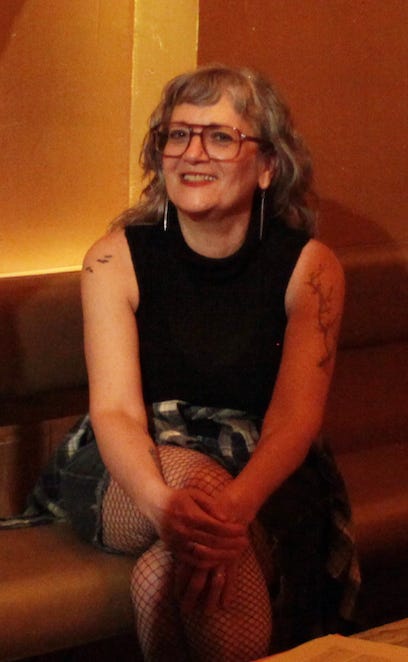
I’m very excited about today’s interview! Memoirist, anthologist, and Substack superstar Sari Botton (who runs Oldster Magazine and Memoir Land) was kind enough to answer my questions on aging and ambition, writing and editing, building an author platform, and so much more.
I suspect that most of you already know who Sari is, but if not, she’s the author of the memoir in essays, And You May Find Yourself...Confessions of a Late-Blooming Gen-X Weirdo, she was chosen by Poets & Writers magazine for the 2022 edition of its annual "5 Over 50" feature, and for five years, she was the Essays Editor at Longreads. She has also edited the bestselling anthologies Goodbye to All That: Writers on Loving and Leaving NewYork and Never Can Say Goodbye: Writers on Their Unshakable Love for New York.
In short, she’s working her ass off! And inspiring many other writers to do the same, including me.
Alexis: Your Substack, Oldster Magazine, “explores what it means to travel through time in a human body at every phase of life.” From the good to the bad to the ugly, and what “getting older” means at different junctures. What do you think people are really searching for when they gravitate toward writing (and reading) about aging, grief, reinvention, and identity?
Sari: As with every human experience that brings people to something previously unknown—that likely makes them feel unsure and vulnerable—people want to know they are not alone in their experience of getting older. At least that was the case for me, and part of why I started Oldster. I wanted to know that I wasn’t the only one struggling with changes to my body, ageism on the job front, and anxiety about retirement and end-of-life stuff. I think they also come to Oldster to learn helpful tips from contributors and commenters. The exchange of information in the comments on Oldster posts is next level.
A lot of women arrive in midlife and realize they’ve outgrown versions of themselves they worked very hard to become. How have you navigated this in your own life?
Oh, definitely! I wrote a whole memoir-in-essays about it called And You May Find Yourself: Confessions of a Late-Blooming Gen-X Weirdo. So many women who respond to The Oldster Magazine Questionnaire write about how, later in life, they are returning to a truer version of themselves, a version that preceded performing gender and professional striving. I feel like that’s happening for me, too. You reach a point where you realize how much you were pretending so that you could grasp those brass rings, and you can no longer keep it up.
You’ve edited so many personal essays over the years at Longreads, and for your two anthologies, Goodbye to All That and Never Can Say Goodbye, and now Oldster Magazine and Memoir Land on Substack. What separates the essays that stay with you from the ones that are simply well written?
I don’t know! I have a nearly photographic memory, and I remember almost every essay I’ve ever edited, which is insane, because I’ve edited a lot of personal essays! Sometimes I’ll run into someone whose essay I edited for Longreads in like 2016, and I’ll say, “Oh, yeah, you wrote that piece about X in which Y and Z happened,” and they are astounded that I remember it in such detail. I’ve always been deeply affected by personal narratives of all kinds, by writers at all levels.
There’s often pressure for personal essays to “resolve” neatly by the end. Do you think readers (and writers) are becoming more open to uncertainty, contradiction, and unresolved emotions?
Oh, definitely. I think this is a trend that has been in motion for some time. The hard part is steering writers away from artificially tying things up neatly in a bow at the end.
Your work explores aging with honesty rather than panic or forced positivity. What do you think mainstream conversations about aging still get wrong, especially for women?
Despite an ongoing movement to change the conversation, ageism, especially gendered ageism, is alive and well. There’s still a lot of condescension from younger people, and sometimes they’ll performatively try to show me how wonderfully accepting of us they are, in a way that seems self-congratulatory to them. “Look at me talking to an older person like she still matters!”
You’ve built a meaningful literary platform outside of traditional legacy media. What have you learned about creating genuine community online?
I can’t say enough good things about literary citizenship. Get to know other writers, either online, in person, or both. Go to book events, go to literary events, and join a writers’ group. These are great ways to meet like-minded friends who can support each other in a challenging creative field—although not in a transactional way. There’s no guarantee that if you support someone in some way, it will come back to you in that exact way later on. But membership definitely has its advantages, to paraphrase an old American Express ad.
How has your relationship to ambition changed as you’ve gotten older?
I’ve come around to competing with myself instead of other people. Actually, it’s not really competing with myself—it’s improving upon what I’ve done in the past, and striving further. Generally, I’m not a competitive person, and I think that helps me keep going when others around me succeed first.
What’s something you understand now about adulthood or womanhood that your younger self couldn’t have imagined?
That on some level, most people don’t feel like they are fully adults. We all seem to retain some essence of our child-selves, and we also look outside ourselves for guidance from “the real adults,” whoever they might be.
Like many writers, I often struggle with how much of myself to reveal on the page. How do you personally decide what’s too private versus emotionally necessary to share?
I’m naturally prone to oversharing. I always have been. I believe that when you share vulnerably, you do a tremendous favor to others who have had similar experiences, helping them know they are not alone. In terms of what not to share, I keep in mind this guideline from The Moth: “Write from your scars, not your open wounds.” So I mostly try to only share publicly what I’ve processed, what I’m able to make valuable sense of.
You recently announced that you’re working on a new anthology springing from your Substack, Oldster Magazine. Congratulations! Was it your goal when you started Oldster to eventually turn it into a book? Did you seek out a book deal, or were you approached because of your success on Substack and your NYT feature?
My agent and I had a book proposal for the Oldster anthology ready to go for a while. She strategically waited until after the NY Times piece was published to take it out, and that put us in a very good position. Eight publishing houses were interested.
Before we go, a few rapid-fire questions
What book have you been recommending to everyone lately?
I always recommend Traveling Mercies by Anne Lamott because it’s probably my favorite book, and the one that made me a writer.
What show or movie are you binge-watching?
Season 11 of Grantchester, my favorite cozy British murder series.
What’s one piece of advice you’d give to every aspiring author?
Don’t be in a rush. Take your time and let your work evolve.
What’s one thing you wish were different about the book publishing industry?
I wish publishers would give more chances to more writers who didn’t come up with great privilege and access.
What’s your top tip on building an author platform?
Don’t be bashful or self-deprecating when sharing your work. A well-respected book publicist taught me that. She said, “Stop making fun of yourself on social media.”
Subscribe to Sari’s Substack publications and follow her on Instagram to stay in touch!
Thanks for reading! If you have any questions for Sari or me, drop them in the comments below.
See you soon,
Alexis
P.S. If you enjoyed this post, hit the ♡ button below and/or share it to help others find it. To further support my work, consider upgrading your subscription. Thanks so much.
Thank you for the reminder to continue to be vulnerable! I also use the guiding principle of writing from the scar, not the wound, but at times know I can go deeper. It's a practice.
Her answers are so supremely confident. I wonder if Sari has any ambivalence at all about her own aging? I sure do!