

What does it actually mean to be “rich”?
"What matters much more to me is having a very healthy work/life balance while I’m still working."

Hello,
As I get older, being “rich” is no longer just a question of How do I make more money? It’s more about building a life that feels rich right now, and that can sustain me into the future. But I’m still working out exactly what that looks like…
I dream of early retirement, or at least I can’t imagine still doing what I’m doing now when I’m 50, but I also love working. What would I do with my time? I’ve been thinking a lot lately about part-time work. I don’t have kids to support, so why not do less freelance work and enjoy life more? Should we be normalizing part-time work in midlife? (I think so.)
It feels a bit frivolous to even say that, especially because I’m 40, which means I should be at or approaching my career peak, according to societal norms. But that point of view feels antiquated to me, or maybe it’s just that I’m currently (and happily) in a slower phase of life.
Anyway, my curiosity about this topic led me to Pauline, a money psychology specialist and the writer behind Money Feelings.
In today’s Q&A, Pauline shares her thoughtful take on financial independence, work-life balance, burnout, and the psychology behind how we plan for our future selves.
I hope you enjoy it!
Mera Magazine is reader-supported — show your love and stay in the know.
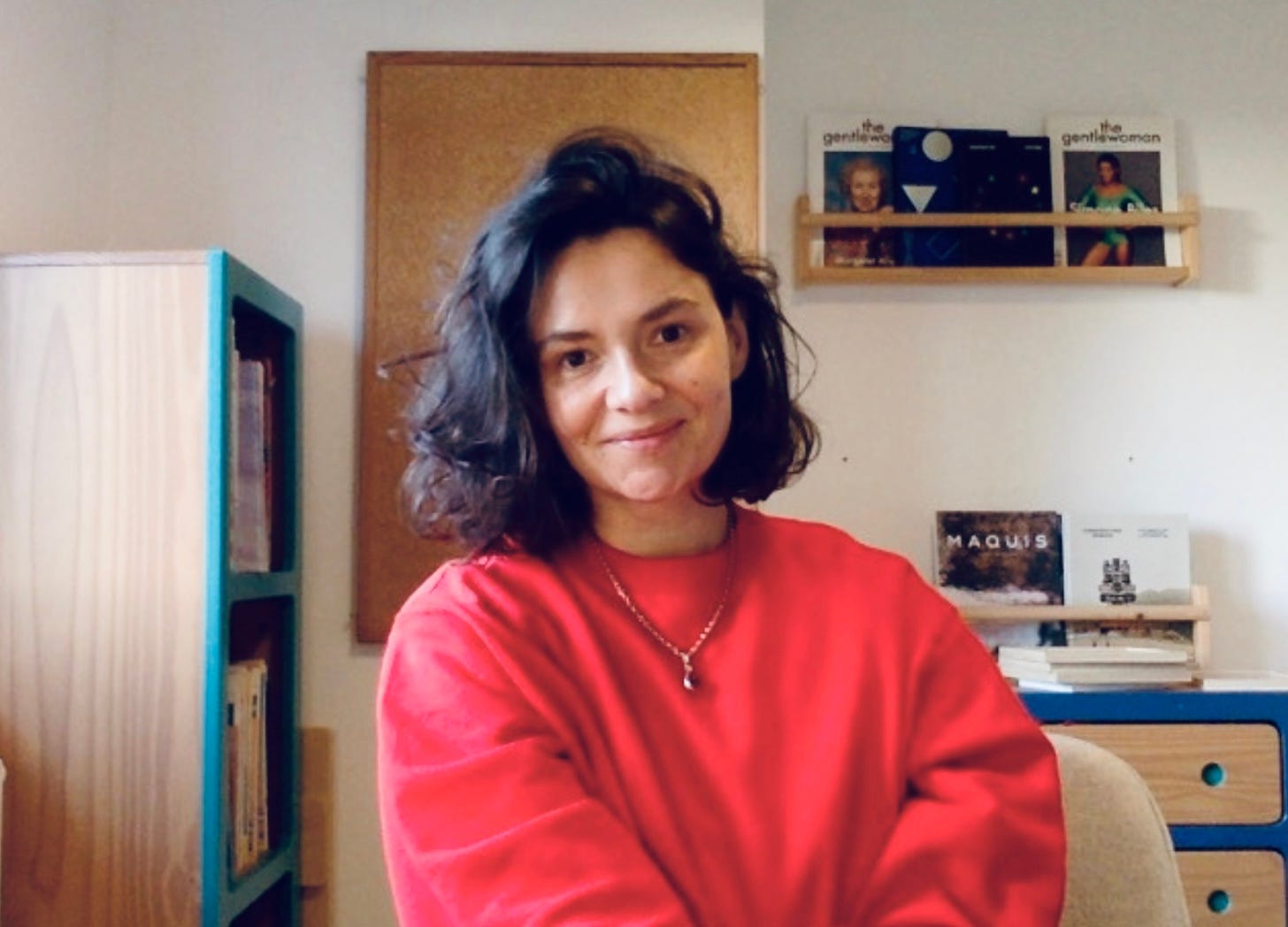
Hello, hello! First, could you tell us who you are? How old are you, where do you live, what do you do? Are you single, living with a partner, married? Do you have kids? What’s your story? I don’t mean to be so direct, but this part is obviously important because it affects how you plan for the future.
Hi! I’m Pauline, I’m 42, I’m French, and I live in Amsterdam. I’m married to a wonderful Belgian man whom I met in Luxembourg and married in London. We have two boys (5 and 8) who were born in the Netherlands and mainly identify as Amsterdammers.
I’m a personal finance educator specialised in behavioral finance and money psychology. I write Money Feelings, the Substack newsletter on the psychology of money. I’m a member of Snowball, the French collective of personal finance newsletters, where I write (in French) the behavioral finance newsletter for investors, Snowball Thérapie. I also consult for companies in the personal finance and mental health space, helping their clients spend better, invest better, and feel better.
I studied law, and after getting my degree, my first job was researching legal frameworks for gambling, and more specifically, which frameworks minimize problem gambling the most. That was my first step into the world of money and money psychology. I was later hired as an editor specialised in financial education for an investment platform whose mission is to democratize investing. That’s where I discovered the topics that truly made me passionate about my work: financial health, financial psychology, women’s financial independence, sustainable investing, and, more generally, money as a tool for health and social change.
It also makes sense when you know that my dad worked in accounting and finance his whole life, and my mom is a therapist — classic apple-falling-right-between-the-two-trees kind of situation.
Interesting! My career has been quite different from my parents and step-parents, who worked in finance, law, and medicine. I think I know the answer to my next question, but when and how did you learn about money, saving, investing, and financial planning in general?
I learned a lot from my dad, who regularly talked about these things with me, even when I was a kid. I know I’m considerate about where my money goes thanks to him. He taught me how to use it as a tool for fun and pleasure, but also in a way that takes care of my future self.
I learned the more technical aspects of investing when I was hired as an editor for an investment platform. The learning curve was very steep, but incredibly rewarding and useful.
When you hear the phrase “early retirement,” what does it mean to you?
Early retirement for me means not relying on earning new income to live the life I want to lead, before my 60s. It’s also not something I’m actively pursuing, btw. I don’t feel the need to retire early. What matters much more to me is having a very healthy work/life balance while I’m still working.
What do you see as the biggest misconception about retiring early or stepping back from full-time work? In other words, what do you think we often get wrong when we talk about financial independence or “retiring early”?
Two things:
First, I often hear people tell me they can’t imagine not working anymore, that they enjoy working too much. But you can be “retired” or financially independent and still “work” in a way, contributing to society. The difference is that you no longer need the money. It opens up a really interesting conversation about our relationship with work. I completely understand the need to contribute, but do we really need financial compensation to feel that we contribute? How much of our sense of usefulness and self-esteem is tied to being paid? And one of my favorite questions: if income disappeared from the equation, what would we choose to work on?
Second, if people find the right balance for themselves and reach financial independence early, I think that’s wonderful. The one thing I’d be very careful about is making work the one and only focus of your life to get there. Again, I’m extremely careful about my work-life balance.
The last thing I want is to overwork now so I can retire early later. I want to enjoy my life at every stage — my husband and I are very much in our “parenting era” right now, so spending time with our kids is our absolute priority. Of course, I need to work, but I never want to overwork during these years (whether or not I plan to retire earlier down the line). I care about making the most of my life right now. For my husband and me, that means finding the right balance between working enough to sustain our lives and having as much time as possible to enjoy our family life. And it’s not like I see work time opposed to fun time. I LOVE my work. But I want my life to be “rich” and, for me, that means experiencing a lot of different things, trying new things, learning new things, and discovering new places. It means I’m forcing myself not to work all the time and make space for all these things.
I’d like to be “rich” in the same way… What life experiences have shaped how you think about money, work, and long-term planning?
I grew up in a financially secure environment. We never experienced scarcity, and when there were some money tensions, I know my parents didn’t overshare their anxiety with my brother and me. I’m very grateful for that. I was also able to see my parents enjoy their money while staying mindful of their future and their kids’ futures.
Time, health, and experiences are the most precious “things”.
One belief and habit I’ve clearly adopted from them, and that my husband and I really share and cherish, is that time, health, and experiences are the most precious “things”. Through my work, my conversations with clients and readers, and my training with the Trauma of Money Institute, I’m very aware of how lucky I am to have had this experience growing up. A lot of what we call “good” money behaviors are just the result of a privileged starting point.
How realistic is “partial retirement” for you, and what would it look like in practice?
I’m currently far from a “partial retirement” situation, but I’m a solo entrepreneur, and one of my business goals each year is to slowly reduce my working time. Right now, I’m able to take many of my kids’ school holidays off to spend time with them, and I’m already really proud of that. Over the next few years, I’d like to drop something like half an hour to one hour of work a day every year.
I recently read On Writing by Stephen King, and he describes his work routine as working only in the mornings, which for him meant focused writing, and then walking, reading, or doing other things in the afternoon. That felt like a wonderful goal to work towards for me.
Great book. I’d love to reach that goal as well — we have a lot in common… In your opinion, what are we actually craving when we talk about leaving full-time work earlier?
I can’t speak for everyone, but for me, it’s a few things.
More creativity, especially doing things with my hands. I LOVE CRAFTS! (Caps needed.)
More disconnection, less screen time, whether it’s phone or computer. We talk a lot about problematic phone use, but I really wish I wasn’t on my computer screen so much either.
More movement. I hate the idea of sitting in a chair so much. Sedentarity is killing us, and I just want to work less or differently so I can get back to what my body should be doing = Not sitting all the time! I’ve invested in a standing desk and a walking pad, but working less for me will definitely mean moving more.
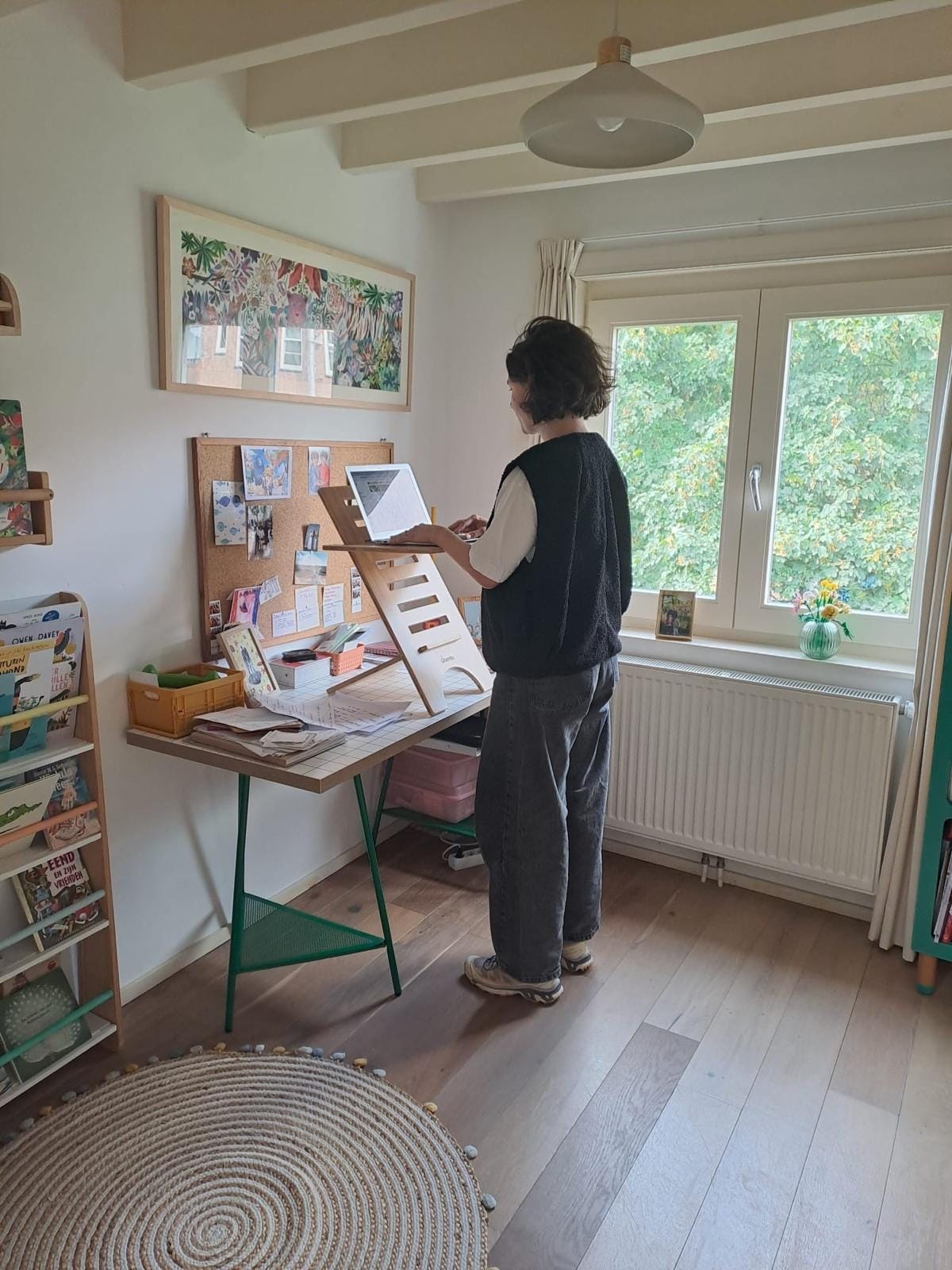
“Photo of my beloved stand-up desk,” says Pauline.
I love crafts too! My friends and I try to organize a monthly craft night. Cheers to less screen time and more movement. Let me know once you’ve cracked the code on all that. Meantime, what small shifts do you think we can make in our 30s or 40s to have a meaningful impact on how flexible our lives can be by our 50s?
Connect with your 50-year-old self today! Like, really think about her/him.
As humans, we’re incredibly good at imagining the future, but something we almost never do is imagine ourselves in the future. And that’s why we often treat our future self worse than we treat our present self. Because we don’t really know this person, our brain treats her/him like a stranger and therefore with less empathy.
I loved reading Your Future Self by UCLA psychology professor Hal Hershfield. His research shows that connecting with your future self helps you take better care of it. Very concretely, people who feel more connected to their future self tend to have better eating habits and save more!
I talk about this a lot on Money Feelings, but for instance, you could ask yourself: what would an ideal day look like when you’re 50? How would you like to move? Who would you like to spend time with? Where would you like to go? Even picturing what you might look like in your 50s helps. All of this will give your brain a clearer image of the future you and help you treat her/him with more empathy and kindness!
I’d like to imagine that I’d be somewhere warm (with access to padel courts), working part-time from a beach chair, and sipping a cold beer — just throwing the idea out there into the world!
What emotional or psychological factors do you struggle with most when planning for retirement or financial independence?
I don’t really struggle with emotional or psychological factors around this anymore. Through my work, I develop exercises to help my readers work through things like fear of the future, procrastination, disconnection from their future selves, or difficulties delaying immediate gratification, and I apply those exercises to myself as well.
For instance, the vision board exercise focused on imagining my retirement years worked so well for me that whenever I think about that phase of my life, my brain immediately goes to the images I pictured and planned for myself. Thinking about retirement doesn’t bring me anxiety anymore; it brings up very concrete images of joy and (swimming) adventures, and it’s so motivating to actually do concrete things, like putting extra money into my pension pot when I can.
Mera Magazine is reader-supported — your support helps keep it alive!
Do you think dreaming of early or partial retirement could be rooted in burnout versus a genuine desire for a different kind of life, in some cases?
100%. How can we work all the time, and for so long, in a society that still glorifies overwork, constant availability, and productivity at all costs, while we’re also now expected to reply instantly on WhatsApp, be constantly exposed to distressing news from all over the world, keep up with new trends on social media, deal with endless notifications, and still juggle family life, friendships, health, etc? It was so tiring writing this sentence.
Oof, yeah, I feel that. I love how easy it is to stay connected with family and friends, especially living abroad, but sometimes I want to throw my phone and laptop out the window…
What trade-offs do you consider making when imagining early or partial retirement?
The biggest trade-off for me is choosing time and flexibility over maximising income. That’s a conscious decision I’m comfortable with.
What’s one question that you think we should be asking ourselves about money and the future — but we usually aren’t?
What kind of life am I actually trying to create with this money?
I love that, mainly because sometimes it just feels like we’re “supposed” to follow a conventional path, but we’re not all aiming for or working toward the same things. On that note, what money topics do you wish more people would talk about?
The incredible feeling that financial well-being brings! We don’t talk enough about the joy of being financially healthy. I’m not talking about financial independence or being “rich”. I’m talking about feeling financially secure, like knowing that if something comes up, you’ll be able to deal with it, not feeling constant anxiety about your future self, and feeling calmer and more in control of your choices.
Money management also brings a lot of dopamine, because you’ll feel proud, knowledgeable, and powerful!
Also, money topics are always framed through fear and anxiety, and dealing with your finances is seen as such a burden. But we forget to say something really important! Handling your money actually feels GOOD. It’s not a choice between dopamine-inducing activities and the misery of managing your finances. Money management also brings a lot of dopamine, because you’ll feel proud, knowledgeable, and powerful! It’s also one of the most long-lasting acts of self-care you can give yourself. Your future self will still be benefiting from it years and decades later.
That’s a great way to frame it. What financial management and planning tools, platforms, communities, etc., do you use and recommend?
Money Feelings, obviously. :)
Otherwise, on Substack, I highly recommend Healthy Rich by Dana Miranda and The Purse by Lindsey Stanberry. If you read in French, Snowball is the best personal finance media I know. And I’m not talking about the newsletter I write for them. I’m proud of my work, but I’ll let others comment on that. Snowball is a collective of newsletters, and the quality of the writers I work with is, honestly, incredible. I read in French, English, and more and more in Dutch, and it’s genuinely the best personal finance media I’ve encountered across languages.
If you really want to get to the root of your relationship with money, I also can’t recommend the Trauma of Money program enough. It’s a psychoeducational and certifying program for professionals, and I learned an enormous amount in the safest and kindest atmosphere surrounded by incredible people from all over the world.
Thanks so much for reading this Q&A on money and retirement (more interviews on this topic and others are coming soon). A big thank you to Pauline for answering all my questions!
Readers, here are a few prompts from Pauline’s interview to encourage further discussion in the comments section of this post. Would love to hear (or rather, read) your thoughts!
If income disappeared from the equation, what would you choose to work on?
What would an ideal day look like when you’re 50?
What trade-offs do you consider making when imagining early or partial retirement?
See you soon,
Alexis
💬 P.S. Have personal finance or money psychology questions for Pauline? She has kindly agreed to answer your questions in the comments, so ask away!
Thank you so much for inviting me, Alexis. I loved answering your questions (and I love an opportunity to show off my cute stand-up desk!!)