


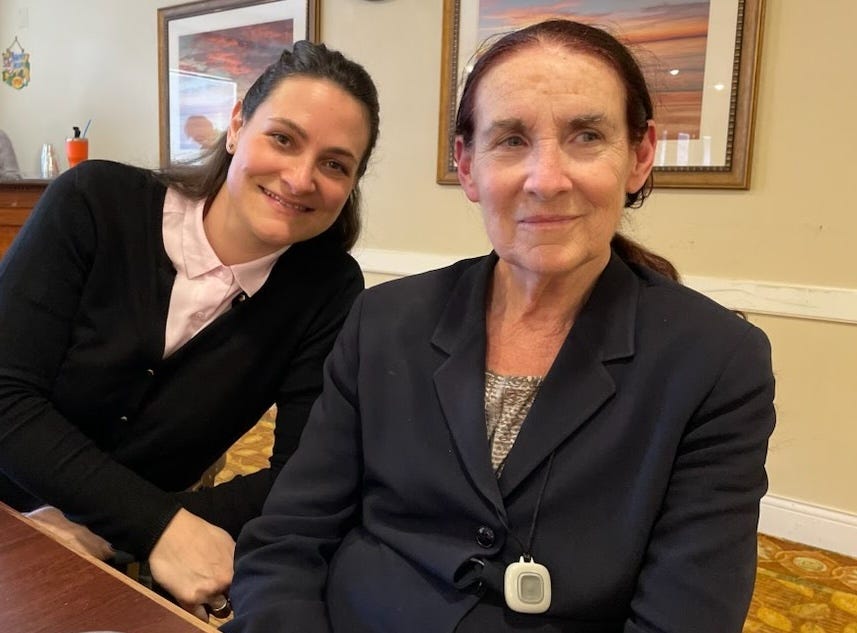
September is World Alzheimer’s Month, which I honestly didn’t know until I started doing research for my work-in-progress memoir. Coincidentally, my mom was diagnosed on World Alzheimer’s Day, September 21st.
I’ve been trying to find something meaningful to share during this time to help with Alzheimer’s awareness. I’ve realized that the hardest part—as someone witnessing it—was all the misconceptions around the disease, or just a general lack of understanding of all that it entails.
This is by no means an exhaustive list, and it’s in no particular order, but it’s what I wish more people knew about Alzheimer’s. At the end, I’ve shared information about raising money to help support Alzheimer’s caregivers.
It’s so much more than memory loss and forgetfulness—the TV remote becomes the telephone, playing cards become money, and cooking a meal becomes a foreign language, to name a few examples.
The person living with it changes almost daily, to the point that it feels like the disease has erased their personality.
That said, occasionally you recognize small parts of them from before Alzheimer’s. But it’s fleeting.
It’s hard when someone is still alive but doesn’t know to call you on your birthday, but it’s even harder when they’re no longer there for you to call them on your birthday and theirs.
You must meet them where they are, and that’s not always easy, but it is a great lesson in patience.
Eventually, they will need 24/7 supervision and care for their safety and your peace of mind.
You learn to love each new version of them; it’s challenging in the moment, but beautiful in retrospect.
In my mom’s case, she became uninhibited and said exactly what was on her mind; I loved it.
She also started drinking beer through a straw, which we found hilarious and supported.
I thought it wouldn’t feel that different after she died because I felt like I had already lost so much of her. But it’s SO DIFFERENT.
First you lose the person mentally, then physically.
“They’re in a better place now.” Or, “They’re no longer suffering.” Are, in theory, nice things to say, but they don’t really help. I prefer, “Alzheimer’s fucking sucks.”
Anticipatory grief is like holding your breath for a really, REALLY long time.
I don’t think many people understand anticipatory grief because we’re more accustomed to grieving someone once they’re gone. That’s ok, but it’s isolating.
You expect to feel relieved when it’s “over”, but in my case, I felt confused and somewhat numb at first.
In the later stages, I often wondered if my mom still recognized me, but then she’d say something like “Ok, honey.” Or at the very end, she kissed my cheek after I kissed hers, so I think somehow her body knew it was me.
In the end, it’s harder for those witnessing it than for the ones living with it, at least that’s how I feel.
You often wonder if you’re next and question your own mortality, especially if something slips your mind.
Becoming a caregiver—in any capacity—and then having that role end is a complete mind and identity fuck.
People will speak as though your loved one is not in the room, when they’re right next to you. You must advocate for your loved one because they no longer can.
Sometimes I wish I could forget the whole experience, but in the 1,563 days that my mom was living with Alzheimer’s, I learned a lot about her and myself that I may not have otherwise.
I’m sure I’ll think of more, but let’s leave it at 21 things for now.
I also want to share Hilarity for Charity with you. Founded by Lauren Miller Rogen and Seth Rogen after Lauren lost her mother to early-onset Alzheimer’s, the organization uses comedy and popular culture to make dementia and caregiving more visible. In 2025, HFC raised more than $28 million and provided more than 475,000 hours of free in-home care to families.
That’s huge. Especially considering that, according to the Alzheimer’s Association’s 2026 Facts and Figures report, an estimated 7.4 million Americans aged 65 and older are living with Alzheimer’s, a number projected to reach nearly 13 million by 2050. Nearly 13 million Americans already provide unpaid care to someone with Alzheimer’s or another type of dementia, amounting to more than 19 billion hours of unpaid care—and valued at more than $446 billion—in 2025 alone.
For the rest of this year, I am donating all my earnings from this Substack to Hilarity for Charity.
If you’d like to help me raise money for Hilarity for Charity, you can do so by becoming a paid subscriber. Or if you’d prefer to donate directly, let me know how much you donated (by replying to this email or contacting me at alexismeradamen@substack.com), and I will match donations up to a total of $500.
As always, thanks for reading!
Take care,
Alexis
Thank you so much for sharing this. My grandfather had Alzheimers and as the person responsible to his care, it was everything you wrote about. And everything you didn't. 🧡. #6 is sooo true. And what is also true of most people I know who have had to make the decision to move their loved one into full time care is that it will require every ounce of emotional strength you have to make that happen. Not to mention it will also require every dollar you ever saved and they ever earned.
But it was #3 and #16 that especially resonated with me because while he was still communicative, there truly were occasional glimpses of the much younger man he was while I was growing up. And like you, I also always wondered at the end if he even knew who I was. He never gave any indication that I was anything other than a nice lady who would come and visit him. But one day, just a few days before he died, I walked into his room and as I came around the curtain, his face lit up and clear as day he said, "Heya Kid!" And I was like, OMG! But the minute I said, "Hey Gramps!" his face got all confused again and he was gone. I don't know if he actually knew who I was or if he thought I was someone else and my voice didn't match it or if it literally was just a split second of recognition. I hope it was split second. Because it makes me want to cry even now almost 20 years later thinking of it.
All of this to just thank you for sharing. And I'm sorry for your loss.